
A Thai shopper taps your ad at lunch, browses a product page on mobile, then asks a question on LINE before checkout. If those moments live in separate systems, your brand feels forgetful.
That gap is why LINE CRM integration matters so much in 2026. High-level customer engagement in 2026 requires seamless data flow. For Thailand consumer brands, LINE is often where identity, service, loyalty, and repeat purchase meet, so the real job is not sending more messages, it's building one continuous customer memory.
For many brands in Thailand, LINE Official Account is no longer a side channel. It's the place where a prospect becomes a known customer, where service issues surface first, and where repeat buyers expect quick answers. Local solution providers still describe it as a mass-reach platform that uses the Messaging API to connect to external databases, with SB Telecom's overview of CRM with LINE citing more than 50 million users in Thailand. That scale shapes behavior inside beauty, retail, food, wellness, and lifestyle brands.
What matters more than reach, though, is context. A customer may add your brand on LINE after seeing a creator video, visit your ecommerce store that night, buy in-store on the weekend, then return to LINE for delivery updates or a points question, all to drive customer engagement. If the CRM only knows one of those steps, your next message lands cold.
LINE Official Account is strong because it blends messaging, service, content, and conversion in one familiar space. Add LINE Login, a Mini App, or event-based messaging, and the channel starts to act less like a source of broadcast messages and more like a customer layer. Vendors such as Audience IQ's LINE CRM page and Crescendo Lab Thailand both frame this clearly: brands use LINE to collect customer data, manage relationships, and support loyalty, not only to push promotions.
The implication for decision-makers is simple. If LINE is a top customer touchpoint, it can't stay disconnected from your CRM, CDP, or service stack.
If LINE knows the conversation but your CRM doesn't know the customer, personalization breaks on the next message.
A good integration does not start with the chatbot. It starts with customer data centralization via a shared customer ID, clean event data, and clear rules for consent, profile updates, and message triggers.
In practice, most Thailand consumer brands need LINE connected to six systems: CRM, CDP, ecommerce, POS, loyalty, and helpdesk. Analytics sits across all of them, providing a unified view. Each system answers a different question. CRM knows the customer record. CDP unifies behavior. Ecommerce tracks browse and cart events. POS captures store purchases. Loyalty tracks points and tiers. Helpdesk keeps service history. When LINE draws from all six, your messages stop feeling random.
This is the simplest way to map the stack:
| System | What LINE should receive or send | Why it matters |
|---|---|---|
| CRM (e.g., Salesforce, HubSpot CRM) | Contact ID, profile fields, lead status, owner | Sales and service teams see the same customer |
| CDP | Events, segments, suppression rules | Messaging follows behavior, not guesswork |
| Ecommerce platform | Product views, carts, orders, returns via Messaging API | Enables cart recovery and post-purchase flows |
| POS | Store purchases, location, receipt data | Connects offline spend to LINE loyalty and reactivation |
| Loyalty system | Points, tier, rewards, redemptions via third-party integrations | Makes rewards visible and usable inside chat |
| Helpdesk | Ticket status, issue type, CSAT, resolution via third-party integrations | Keeps service and marketing from colliding |
| Analytics layer | Open, click, conversion, revenue data | Proves what messages drive value |
The strongest setups use two-way sync where possible. A new LINE friend can create or enrich a customer record, while a store purchase or loyalty milestone can trigger a LINE message. That's the difference between a static contact list and a living customer journey.
Acquisition matters here too. If paid social and creator content drive traffic into LINE OA, the friend-add flow and profile prompts need the same logic as your broader Thailand social content strategy. Otherwise, you'll pay to acquire contacts you can't identify or segment well.
The best LINE CRM programs do not begin with broadcast calendars. They begin with moments that customers already expect.
A common starting point is lead capture. A prospect sees a campaign, adds the brand's LINE OA, and receives a welcome flow with a small incentive, a preference prompt, or a store locator. At that point, the system should handle lead management by writing basic data back to CRM, tagging source and campaign, and asking for one or two useful fields only. If you ask for too much, drop-off rises.
For higher-value categories such as beauty devices, insurance-like wellness plans, or premium home products, lead qualifying during the handoff can route to a sales advisor inside the same thread. The CRM should log that conversation, not leave it trapped in chat.
Cart recovery is where many teams see the first clear revenue lift. When ecommerce and LINE are linked, workflow automation powers a reminder tied to the actual product category, price band, or urgency for a shopper who abandons checkout. The message should respect frequency caps and recent behavior. If the customer already purchased in-store, suppress the reminder.
That is why integration beats manual campaign work. The message is not "we miss you." It is "your size is still available," "your basket is waiting," or "your member price expires tonight," based on real data.
After checkout, LINE becomes even more useful for customer support. Order confirmation, delivery updates, how-to content, warranty registration, and review requests all belong here if timing is right. A linked loyalty system can show points earned after purchase and suggest the next redemption step. Crescendo Lab's Thailand page leans into this long-term value view, where customer data on LINE supports retention and lifetime value, not only first conversion.
Service matters as much as sales. When helpdesk tickets sync with CRM, the brand can pause promotional sends during an open complaint, then trigger a satisfaction survey or win-back offer after resolution. That simple rule protects tone and trust.
Re-engagement works best when it uses behavior, not calendar pressure. A brand can build segments such as "high-value buyers with no purchase in 60 days," "offline buyers who never shopped online," or "members with unused points." Each segment deserves targeted messaging with different creative, different timing, and often different offers.
Some vendors, including Communicat-O's view on LINE OA and CRM, position LINE integration as an omnichannel engine. That framing is useful, but only when segmentation stays grounded in clean inputs and contrasts manual blasts like broadcast messages with behavior-based sends. Bad data creates loud automation.
A strong build starts with architecture, not software demos, to create an automated ecosystem where systems sync without friction. Before choosing a tool, whether you opt for native integration or custom builds, decide which system owns the customer profile, which system owns message permissions, and which events should trigger action. If you skip that work, the project turns into a patchwork of webhooks, duplicate contacts, and campaign exceptions.
Start with identity. Some brands anchor everything to a CRM contact ID. Others use a CDP profile ID and map LINE user data into it. Either can work, but the rule must be clear. Then define your minimum event set: friend add, profile completion, product view, add to cart, purchase, loyalty earn, loyalty redeem, ticket opened, and ticket closed, all powered by precise API calls. Those events cover most consumer-brand journeys without overbuilding.
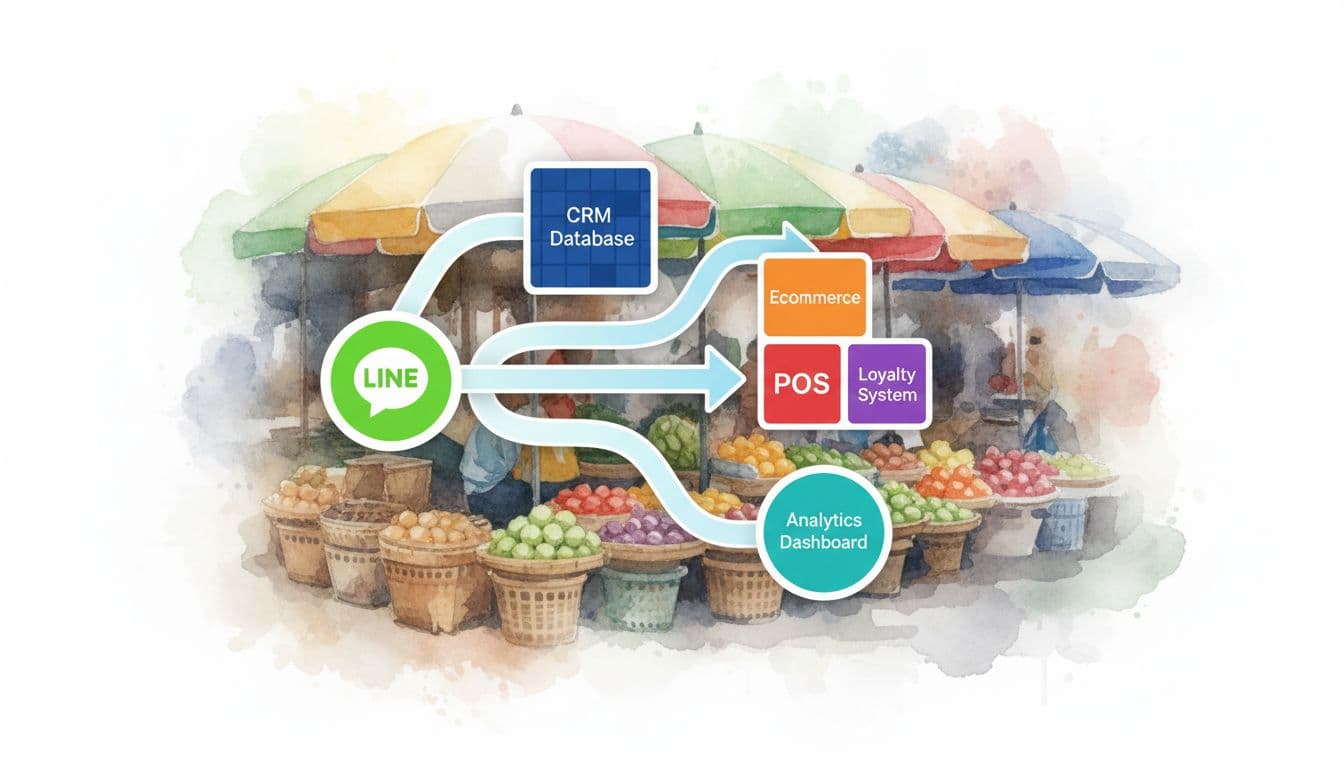
Next, map business rules for your marketing automation workflows. How often can a customer receive messages? What suppresses a promotion? Which events should enrich the profile, and which should trigger a human handoff? These decisions matter more than template design.
For brands with store networks, POS integration deserves extra care. Receipt-level data, store ID, and loyalty ID mapping make it possible to connect a Bangkok mall purchase to later LINE follow-up. Without that link, your CRM treats store buyers like strangers.
Finally, test with one journey at a time. Cart recovery, post-purchase care, and points reminders are good first cases because success is easy to measure. If your team needs a reference point for HubSpot-style connection logic, Our Green Fish's LINE CRM solution page shows the type of CRM-to-LINE mapping many brands now expect in 2026.
Tool choice often fails for one reason: teams buy for messaging volume instead of operational fit. A cheaper platform can become expensive if it cannot sync with your ecommerce stack, handle custom fields, or pass service data back to CRM.
For Thailand consumer brands, a practical shortlist should answer five questions. Can the platform support two-way data sync? Can it pass custom attributes cleanly? Does it handle segmentation beyond tags? Can it route bot conversations to human agents with context to boost service efficiency? Can your team report revenue, retention, and service outcomes in one view? If the answer is no on three of those, keep looking. Platforms like respond.io and Zendesk help bridge the gap between messaging and customer records.
Local fit matters too. A brand with heavy store traffic may need stronger POS and loyalty logic. A D2C beauty brand may care more about ecommerce events, creator-driven acquisition, and rapid campaign testing. A premium brand may put service and clienteling first. There is no single best stack, only a best-fit stack.
Vendor claims also need a reality check. The 2026 market is full of promises around AI chat, funnel automation, omnichannel messaging, and omnichannel reporting. Some are strong. Some are wrappers over manual work. Ask for a live walkthrough of event mapping, suppression rules, and failure handling. Ask what happens when customer records conflict. Ask how the platform logs chat history into CRM. Those answers tell you more than a feature grid.
A good partner should also respect the boundary between campaign thinking and systems thinking. Creative teams shape the message. CRM teams define rules. Data teams keep the IDs clean. When one partner can bridge those conversations, launches move faster and break less.
This year, the biggest shift is not that brands message more. It is that they are finally connecting message logic to customer state.
Across Thailand-focused vendors and local agency builds, three patterns show up again and again. First, two-way communication is becoming the standard expectation. Second, AI-powered chat leveraging generative AI is moving from simple FAQ handling to smarter triage with human handoff. Third, loyalty is moving closer to the conversation itself, so point balances, rewards, and member nudges appear inside LINE rather than in a separate app. LINE Business Connect stands out as a specialized tool for high-volume enterprise data handling.
That last point matters for consumer brands. If the customer has to leave LINE to check points, claim benefits, or find service updates, friction rises. If the brand can answer those needs in-thread using chat history, response and repeat behavior improve. Relevant Audience's LINE CRM overview and Botcake's LINE integration page both point to the same direction of travel: more connected chat history, more cross-system syncing, and more automation tied to lead management.
Still, restraint matters. A mature LINE CRM program is not a flood of nudges. It is a quiet system of relevance in real-time communication, where identity, timing, and business rules shape what the customer sees next. In 2026, that discipline is becoming a brand advantage.
LINE CRM integration links LINE Official Account data—conversations, friend adds, and interactions—to core systems like CRM and ecommerce, creating a unified customer view. For Thailand consumer brands, where LINE is central to identity, service, and loyalty, it prevents forgetful messaging and enables personalized journeys. Without it, promotions land cold because systems don't share context from ads, stores, or chats.
Connect LINE to CRM for profiles and leads, CDP for events and segments, ecommerce for carts and orders, POS for store data, loyalty for points and rewards, and helpdesk for tickets. Analytics layers unify reporting on opens, conversions, and revenue. Two-way sync turns static lists into living journeys, like triggering messages from purchases or enriching records from chats.
Anchor on a shared customer ID (CRM or CDP), define minimum events like friend add, purchase, and ticket close, then map business rules for frequency, suppression, and handoffs. Test with simple cases like cart recovery before scaling. Clear ownership prevents duplicates and ensures events power relevant automation.
Prioritize lead capture with profile prompts, abandoned cart reminders tied to real basket data, post-purchase flows for updates and loyalty nudges, and re-engagement segments based on behavior like unused points. These use precise triggers to feel timely, not noisy. Service integration pauses promotions during complaints for better trust.
Evaluate for two-way sync, custom attributes, advanced segmentation, human handoff with context, and unified reporting on revenue and retention. Local fit matters—POS for store-heavy brands, ecommerce for D2C. Demand live demos of event mapping and conflict resolution over feature hype.
For Thailand consumer brands, LINE is often the place where customer experience becomes visible. Every missed sync shows up as a mistimed offer, a blind service reply, or a loyalty journey that stops short.
The brands getting this right treat LINE CRM integration as core infrastructure, not a side project. They connect LINE to commerce, service, loyalty, and analytics, then build journeys around real customer signals.
With effective LINE CRM integration, when your brand remembers who the customer is, what they did, and what they need next, LINE stops being another channel. It starts acting like a proper relationship system for personalized interactions.


