
On TikTok Shop, discovery and checkout now sit one tap apart. For Thai brands, that changes the job of advertising. Your media plan is also a content plan, a creator plan, and a merchandising plan.
More spend won't fix weak proof. In 2026, the brands winning with TikTok Shop ads in Thailand pair native short video, creator trust, affiliates, and live selling with tight shop operations. This playbook is for brand-side teams that need profit, not vanity reach.
For teams buying TikTok Shop ads in Thailand, 2026 feels less like classic media buying and more like running a store inside a feed. Current patterns are clear: short videos still lead attention, in-app shopping feels normal, creator-led content beats polished brand film, and LIVE commerce keeps growing.
Some of that is global. Some is distinctly Thai. A Southeast Asia TikTok Shop operations guide notes that local-language openings can lift completion rates, which fits how Thai users scroll, judge, and decide fast.
This split helps teams avoid lazy planning.
| What works almost everywhere | What matters more in Thailand |
|---|---|
| Native-looking short video beats polished ad film | Thai-language hooks and familiar local context often lift hold rate |
| Creator proof helps conversion | Comments, reviews, and visible social proof carry extra weight |
| In-app checkout cuts drop-off | Shoppers are comfortable discovering and buying without leaving TikTok |
| Interest signals beat broad demographics | Niche communities and cultural cues often outperform age or gender splits |
That means you shouldn't port Meta catalog ads or TVC cutdowns into TikTok and hope the algorithm saves them. The ad unit, creator voice, product offer, reviews, and yellow basket moment have to land as one experience.
Paid media can speed up demand, but it rarely creates trust without proof on screen.
For marketers, the main shift is structural. The winning account is no longer the one with the neatest funnel slide. It's the one that can test hooks quickly, seed creators every week, watch comments like research notes, and fix the product page before weak conversion turns into wasted spend.
Many brands lose money because they choose ad formats by hype, not readiness. Product names and availability can vary by account, but four buckets matter for most teams.
This quick comparison helps you choose the right starting point.
| Format | Best use | Strength | Main risk |
|---|---|---|---|
| Video Shopping Ads | Testing new SKUs, offers, and hooks | Fast learning with native feel | Weak hooks burn spend quickly |
| Spark Ads | Scaling proven organic or creator posts | Keeps comments, creator identity, and social proof | Won't rescue a weak original post |
| GMV-focused automated shop campaigns | Scaling a broader catalog | Efficient expansion once signals are strong | Needs creative depth and clean product data |
| LIVE promotion | Launches, demos, promo windows | Answers objections in real time | Poor hosting kills conversion |
For most brands, Video Shopping Ads are the cleanest place to prove product-message fit. A Thailand TikTok Shop setup guide recommends starting with native-style shopping videos, modest daily budgets, and scaling only when ROAS holds.
This format works because it keeps the test simple. One product, one angle, one clear action. If Thai users don't stop, watch, and tap, the issue is usually creative or offer, not media mechanics.
Spark Ads are strongest when a post already has signs of life. That can be a creator post, an affiliate clip, or a brand-owned video that attracted strong watch time, comments, or product clicks.
A 2026 TikTok Shop marketing guide suggests finding three to five organic winners before pushing Spark hard. That advice holds up because Spark keeps the social skin on the content. It still feels like a post, not a packaged ad.
GMV-focused automated shop campaigns can scale well, but they are not a shortcut for weak fundamentals. They work best once you have several proven assets, stable SKU data, and at least a few creator videos that convert on their own.
If one hero video carries the whole account, automation often exposes the problem faster. Delivery widens, frequency rises, and weak product pages show up in the numbers.
Most Thai brands should follow a simple rollout path:
That order keeps testing cheap and scaling disciplined.
Organic content is where you find hooks, objections, language, and unexpected use cases. Paid media then turns that learning into repeatable reach. When the organic side is thin, ads become expensive research.
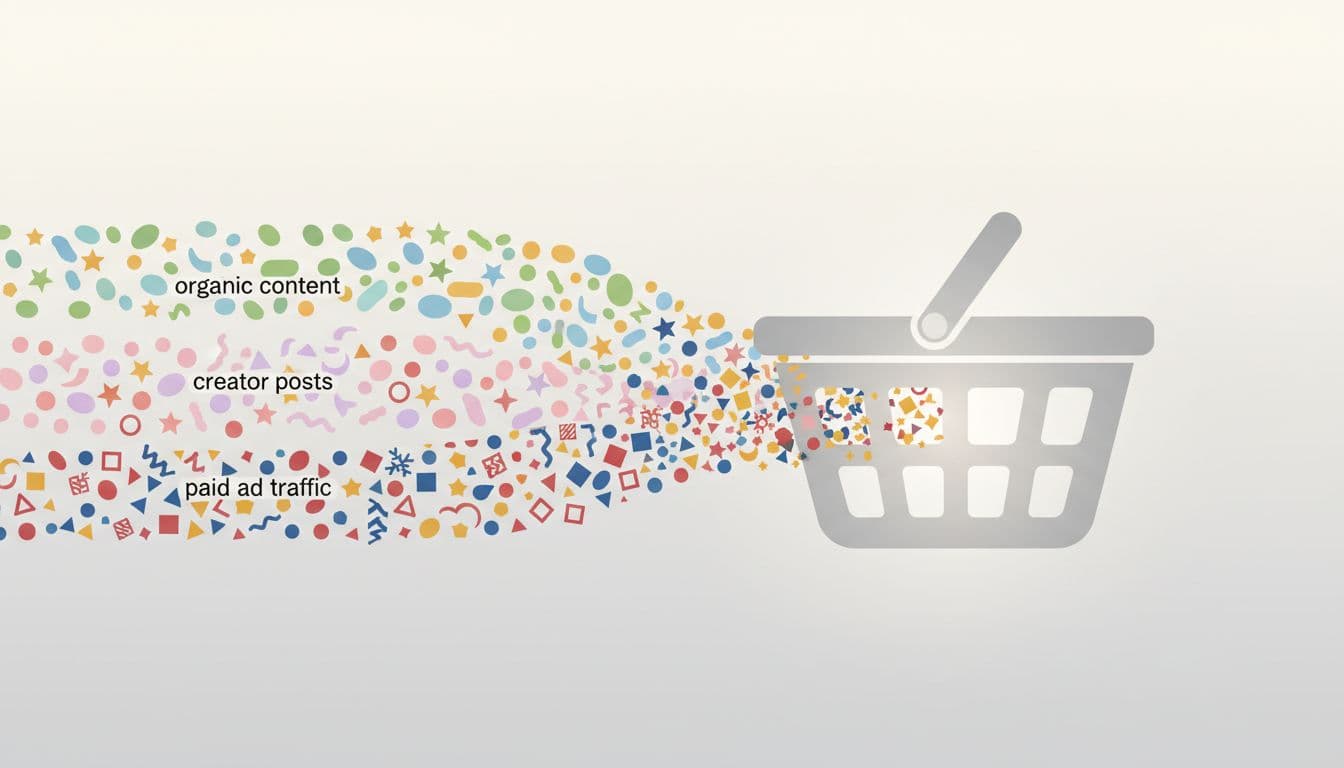
This matters more on TikTok because search, comments, shares, and saves keep shaping discovery. A guide to in-app shopping campaigns points out that users often discover beyond what they first searched for. Helpful posts, creator reviews, and product explainers therefore do double duty. They win organic reach and seed warmer paid audiences.
The best operating model is simple. Organic tests hooks every week. Paid boosts the clear winners. Ecommerce updates the shop page, pricing, bundles, and review strategy based on what comments reveal. If someone asks about size, shade, texture, battery life, or whether the product works in Thai weather, that line belongs in the next video.
A lot of brands break this loop by assigning content, paid, and shop operations to different calendars. Then the paid team scales a video built on an old offer, while the ecommerce team fixes issues nobody briefed them on. Brands that need this feedback loop but lack in-house production often look for professional social media content services so creative and media don't drift apart.
Weekly creative reviews beat monthly campaign decks. By the time a bad hook shows up in a monthly report, the budget is already gone.
Too many brands treat creators as a top-of-funnel add-on and affiliates as discount distribution. On TikTok Shop, both sit much closer to the cash register. A creator who demonstrates the product well can drive the first click, the first comment, and the basket tap.
Pick creators by sales behavior, not follower count. Look for clean on-camera proof, strong retention in the first seconds, and comments that show real purchase intent. Local tone matters in Thailand. The creator doesn't need celebrity energy. They need to sound familiar, useful, and believable.
Affiliates need more structure than many brands give them. Seed products with a clear angle, a fair commission model, simple dos and don'ts, and guidance on what proof to capture. Give them winning hooks, but don't flatten their voice. If every affiliate clip sounds like the brand deck, conversion drops.
LIVE also deserves a larger role in the media plan. A case-based TikTok Shop scaling playbook argues that many brands stall because they skip LIVE while trying to scale on short video alone. In Thailand, live sessions tend to work best when they feel like a shop-floor conversation, with a host, moderator, pinned products, timed offers, and fast replies to objections.
Treat LIVE like a staffed sales shift. Script it, rehearse it, and track GMV per minute.
Use each commerce layer for a different job. Creators spark trust. Affiliates widen product coverage. LIVE closes hesitation. When one team manages all three together, the account learns faster and scales with less waste.
The best TikTok Shop ads in Thailand rarely look polished in the old brand sense. They look close, clear, and useful. The viewer should see the product in motion before they feel sold to.

In 2026, the winning structure is still tight. Open with the problem, the result, or the most satisfying product moment in the first three seconds. Then show the product in hand, on skin, in the room, or in the routine. End with a clear reason to tap the basket now, whether that is a demo result, a bundle, a timed voucher, or a creator recommendation.
A few creative rules keep showing up in winning accounts:
Comment mining is one of the cheapest creative tools on the platform. If people ask about size, scent, shade, delivery time, or how to use the product, those objections belong in the next video. The same goes for LIVE transcripts. Your strongest ad angle often sits in the questions people ask when they are close to buying.
At the same time, "authentic" does not mean sloppy. Bad audio, unclear framing, weak lighting, and slow edits still hurt. Native creative is casual, not careless. In regulated categories such as beauty, wellness, and supplements, the line is even tighter. Avoid absolute claims. Show the use case, the routine, and the visible result in honest terms.
The first benchmark for TikTok Shop ads in Thailand is your own median by product line, creator type, and format. Still, a few 2026 guardrails help teams decide when to keep testing, when to scale, and when to stop.

Use these as operating guardrails, not universal platform averages.
| Area | Guardrail for 2026 | Why it helps |
|---|---|---|
| Video length | Keep most shop creatives under 60 seconds, with many winners in the 15 to 45 second range | Matches current viewing behavior and demo pace |
| Launch test budget | Give a serious test around ฿500 to ฿1,000 per day | Lets delivery and early conversion data settle |
| Spark trigger | Promote only after you see 3 to 5 organic winners | Paid works better on proven hooks |
| Automation trigger | Add GMV-focused automation after 5 or more proven creator assets | The system needs enough signal to learn well |
| Aggressive scale rule | Raise spend only when ROAS stays above your break-even target, and many teams use 2.5x as a rough floor for harder scaling | Protects margin during expansion |
Numbers alone won't save you, because TikTok Shop is a chain of small conversions. Watch five things together: hook strength, click intent, product page action, checkout efficiency, and profit after creator or affiliate costs. If views rise but clicks stall, the creative angle is weak. If clicks are healthy but checkout starts lag, the shop page, price, or offer usually needs work.
For LIVE, track audience retention, comment volume, pinned product clicks, and GMV per minute. For affiliates, watch cost per order, approval speed, content reuse rate, and refund rate by creator. If one creator drives sales but also drives returns, the script may be overselling the product.
Brands that run creative, media, and shop operations in separate silos often miss these links. That's why some teams prefer a full-service digital agency in Thailand when internal ownership is fragmented. The dashboard only makes sense when one group can see the whole funnel.
The first mistake is treating TikTok Shop like a smaller Meta account. Static offer logic, polished cutdowns, and broad demographic targeting often look fine in approval and weak in market. TikTok needs sharper hooks, clearer proof, and content that feels born on the platform.
The second mistake is splitting ownership too far. If paid media owns spend, ecommerce owns the shop page, creators sit with influencer marketing, and no one reads comments, the account moves slowly. Strong brands fix issues in days, not quarters.
Another common miss is scaling one winner until it collapses. Creative fatigue arrives fast. Rotate hooks, creators, first frames, and offer angles before the drop shows up in ROAS. Keep seeding affiliates and fresh creators even when the account looks healthy. Pipelines dry up if you stop feeding them.
Many teams also judge performance too narrowly. Last-click ROAS matters, but it is not the whole story. If a creator lowers CPA, lifts review volume, feeds Spark Ads, and gives you reusable proof clips, that creator is doing more than one job. The same is true for LIVE. A session can improve trust, future click-through, and affiliate output even when the direct GMV number is modest.
A simple weekly routine keeps teams honest:
On TikTok Shop, media buying is only one gear. For Thailand brands in 2026, growth comes from native creative, creator proof, affiliate coverage, live selling, and a shop experience that closes the sale without friction.
The strongest accounts won't chase one viral post. They'll build a repeatable system, test fast, scale the right winners, and protect margin while they grow. When that system is in place, TikTok Shop stops feeling noisy and starts acting like a sales channel you can trust.


